AI agents have moved past the hype cycle. In 2026, they’re not just chatbots that answer questions, they plan, take actions, use tools, and complete multi-step tasks with minimal human hand-holding. Whether you’re a developer, a business owner, or just trying to get more done in a day, there’s an agent built for that.
Here’s our breakdown of the 10 AI agents worth knowing about right now, spanning coding, general productivity, research, and business automation. Want the longer version? Check out our full roundup of 25 AI agent platforms for a deeper dive.
1. ChatGPT (with Agent Mode)
OpenAI’s ChatGPT remains the most widely used AI product in the world, and its Agent mode is a big reason why it keeps expanding beyond simple chat. Agent mode lets ChatGPT execute multi-step tasks autonomously, browsing the web, filling out forms, and operating applications on your behalf. Combined with its huge plugin ecosystem, native image generation, and advanced voice features, ChatGPT is the safest all-around pick for people who want one tool that does almost everything reasonably well.
Best for: General users who want breadth, chat, agent tasks, image generation, and voice in one place.
Curious if the paid tier is worth it? Read our ChatGPT Plus review.
2. Claude (Anthropic)
Claude has built a strong reputation for writing quality, careful reasoning, and coding help. Beyond the chat interface, Anthropic offers agentic tools like Claude Code for software development tasks and Cowork for more general knowledge work, letting Claude plan and carry out multi-step tasks with files and tools rather than just answering one question at a time. If your work leans on writing, analysis, or code, Claude is consistently ranked among the strongest options available.
Best for: Writing, coding, and document-heavy analytical work.
Not sure which one fits you better? See our full ChatGPT vs Claude comparison.
3. Perplexity (Comet / Perplexity Computer)
Perplexity built its name on cited, real-time web search, and it has grown that into a genuine agent platform. Its research tools route tasks across multiple underlying AI models, run jobs in isolated sandboxed environments, and can keep working on a task for extended periods with a wide range of app integrations. For anyone who needs an answer backed by traceable sources rather than a confident-sounding guess, Perplexity remains the category leader.
Best for: Research, fact-checking, and citation-backed reports.
4. Google Gemini
Gemini’s advantage is the ecosystem around it. It plugs directly into Google Workspace (Docs, Sheets, Gmail, Drive) and pairs with other Google AI tools for video, image generation, and note-taking. Its long-context handling and multimodal understanding, reading images, documents, and video together, make it a strong choice for anyone already living inside Google’s tools.
Best for: Teams and individuals embedded in the Google Workspace ecosystem.
5. Devin (Cognition)
Devin was one of the first agents marketed as an “AI software engineer,” and it still sets the bar for autonomous coding on well-defined tasks. It can plan, write, test, and iterate on code with limited supervision, working best on bounded problems rather than ambiguous, wide-open ones. For engineering teams looking to delegate discrete coding tickets, Devin is a serious option.
Best for: Engineering teams delegating well-scoped coding tasks.
6. Claude Code / Cursor / GitHub Copilot (Coding Agent Category)
Coding agents deserve their own mention as a category, since the “best” one depends heavily on your workflow. Cursor is prized for speed and flow inside the editor. GitHub Copilot remains the most widely adopted option thanks to its deep IDE integration. And Claude Code is frequently praised for reliability on large, complex codebases. The common theme across all of them: the agent is only as good as the underlying model plus the “harness” (the tooling) wrapped around it.
Best for: Developers who want an AI pair programmer embedded directly in their editor.
For a head-to-head breakdown, see our OpenCode vs Cursor vs Claude Code comparison.
7. Salesforce Agentforce
Agentforce is Salesforce’s push into autonomous business agents, built on what the company calls its Atlas Reasoning Engine. It uses a reason-act-observe loop to take independent action inside a business’s CRM, updating records, qualifying leads, and resolving support cases without a human clicking through each step. It’s aimed squarely at large sales and service organizations already running on Salesforce.
Best for: Sales and customer service teams already using Salesforce.
8. Fin by Intercom
Fin is a purpose-built AI customer support agent that gives support teams control over how the agent is trained, tested, and deployed, without requiring code. It’s designed to learn from a company’s existing help docs and policies, then handle customer conversations directly, escalating to humans only when needed.
Best for: Customer support teams that want a no-code AI agent trained on their own knowledge base.
9. Manus
Manus emerged as one of the more talked-about general-purpose autonomous agents, designed to take a high-level goal and independently break it into steps, use tools, and deliver a finished result, research reports, spreadsheets, simple websites, and more, with minimal back-and-forth. It’s built for people who want to hand off a task and walk away rather than co-pilot it step by step.
Best for: Delegating open-ended tasks you don’t want to babysit.
Looking for a more experimental, self-hosted option? We also tested Hermes Agent.
10. nexos.ai
nexos.ai is a no-code, all-in-one AI platform aimed at small and mid-sized business teams that want to build custom agents without engineering resources. It bundles ready-made, business-grade agents alongside a builder for creating your own, making it a practical starting point for teams automating routine workflows without a dedicated dev team.
Best for: SMB teams automating workflows without technical expertise.
How to Choose the Right AI Agent
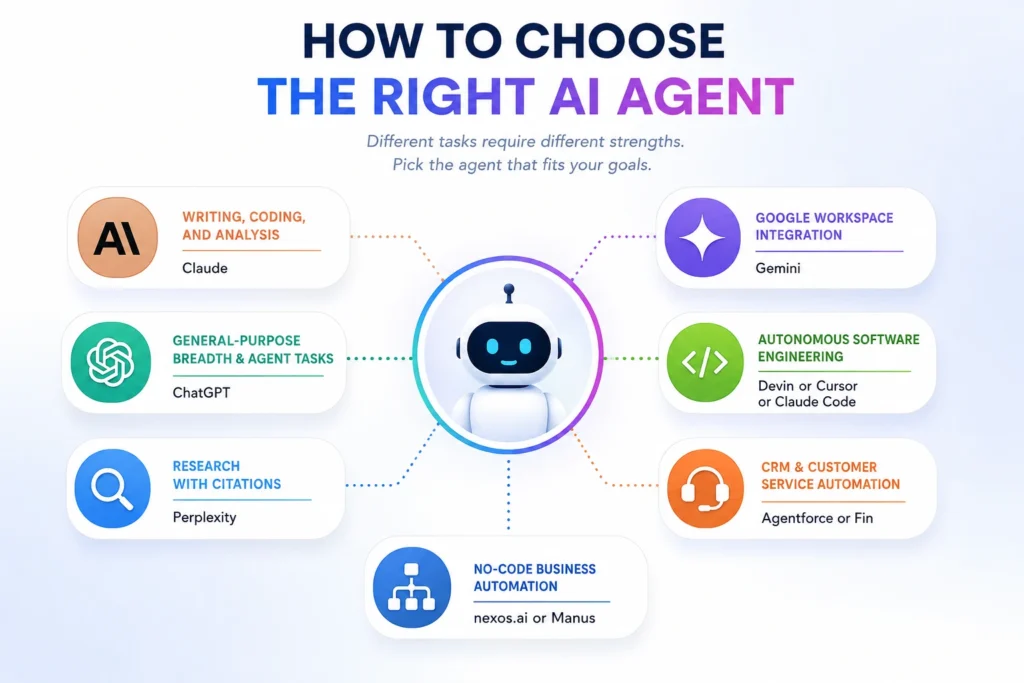
With this many options, the real question isn’t “which agent is best”, it’s “which agent is best for what I’m trying to do.” A rough way to think about it:
- Writing, coding, and analysis: Claude
- General-purpose breadth and agent tasks: ChatGPT
- Research with citations: Perplexity
- Google Workspace integration: Gemini
- Autonomous software engineering: Devin or a coding-focused agent like Cursor or Claude Code
- CRM and customer service automation: Agentforce or Fin
- No-code business automation: nexos.ai or Manus
The AI agent market is moving fast, and today’s rankings will keep shifting. The smartest approach for most people isn’t picking one tool for life, it’s understanding each agent’s strengths and reaching for the right one depending on the task in front of you.
If you want the bigger picture beyond agents, our AI Tool Tier List 2026 ranks the AI tools we actually recommend across every category.
This guide reflects the AI agent landscape as of September 2026. Given how quickly this space moves, capabilities, pricing, and rankings are subject to change.
