There are thousands of AI tools available today.
Some are genuinely useful. Some are impressive for five minutes and then never get opened again. Others look similar on the surface but can completely change how you work once they become part of your daily workflow.
That is why we created this AI tool tier list for 2026.
Instead of ranking AI tools simply by popularity, funding, social media hype, or how frequently they appear on “best AI tools” lists, this ranking is based on real-world experience.
Our goal is simple: identify the AI tools that are genuinely worth your time and put them into tiers based on how useful they are in practical workflows.
And our results may surprise you.
ChatGPT is in D tier.
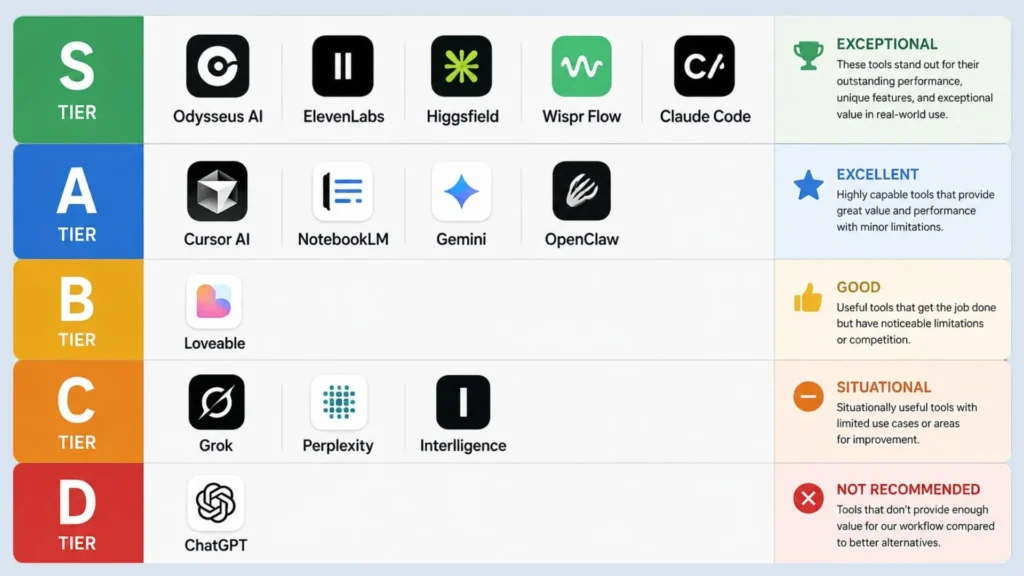
Odysseus AI, ElevenLabs, Higgsfield, Wispr Flow, and Claude Code are in S tier.
That may look very different from the average AI tools list—and that is exactly the point.
AI Tool Tier List 2026
Here is our current ranking:
| Tier | AI Tool | What We Think It’s Best For |
|---|---|---|
| S Tier | Odysseus AI | AI-powered productivity/workflows |
| S Tier | ElevenLabs | AI voice and audio |
| S Tier | Higgsfield | AI video and creative content |
| S Tier | Wispr Flow | AI voice dictation and productivity |
| S Tier | Claude Code | AI-assisted software development |
| A Tier | Cursor AI | AI coding and development |
| A Tier | NotebookLM | Research and document analysis |
| A Tier | Gemini | General AI and Google ecosystem |
| A Tier | OpenClaw | Personal/open-source AI assistant |
| B Tier | Lovable | AI app and website development |
| C Tier | Grok | General-purpose AI |
| C Tier | Perplexity | AI search and research |
| C Tier | Interlligence | AI productivity/use cases |
| D Tier | ChatGPT | General-purpose AI |
Note: These rankings represent our experience with the tools and are not intended to suggest that every user will have the same experience. Your ideal AI stack depends on your workflow, technical ability, budget, and specific use case.
What Do S, A, B, C and D Tier Mean?
Before getting into individual tools, it is important to understand what our tiers actually mean.
S Tier: Exceptional
These are the tools that stand out from the competition.
An S-tier tool does something so well—or provides so much practical value—that we believe it deserves a place in a serious AI toolkit.
These are the tools we would recommend trying first.
A Tier: Excellent
A-tier tools are extremely capable and worth using.
They may have a narrower use case than an S-tier tool, or they may have some limitations that prevent them from reaching the top tier.
B Tier: Good
B-tier tools are useful, but there are enough limitations or competing alternatives that we would not automatically recommend them to everyone.
C Tier: Situational
C-tier tools can be useful depending on what you need.
However, based on our experience, they are not tools we would put at the center of an AI workflow.
D Tier: Not Recommended
D tier does not necessarily mean the product is broken or useless.
It means that, for our particular workflow and experience, the tool does not provide enough value compared with the alternatives.
This distinction is important because an AI tool can be popular without being the right tool for everyone.
S-Tier AI Tools
1. Odysseus AI — S Tier
Our rating: S
Odysseus AI takes the top tier on our list because of the practical value it provides in our workflow.
Rather than judging an AI tool by how impressive its marketing looks, we care about one question:
Does this tool actually make the work easier or better?
For us, Odysseus AI has earned its S-tier position because of its usefulness, workflow potential, and the way it can fit into practical AI-assisted work.
Why we put Odysseus AI in S tier
- Strong practical workflow potential
- Useful for AI-powered tasks
- Can reduce repetitive work
- Fits well into an AI-focused workflow
- Worth exploring for users who want more than a basic chatbot
One of the biggest mistakes people make when evaluating AI tools is assuming that the most famous AI product must automatically be the best.
Our experience has been different.
Sometimes a specialized AI tool can provide considerably more practical value than a household-name chatbot.
Our verdict: S tier.
If your workflow matches what Odysseus AI is designed to do, it is one of the tools we would recommend testing.
2. ElevenLabs — S Tier
Our rating: S
If you work with AI-generated voice, audio, narration, podcasts, video content, or voice-based experiences, ElevenLabs is one of the AI tools we would put at the top of the list.
ElevenLabs has built its reputation around AI voice generation and related audio technologies.
The reason we place it in S tier is simple: it solves a specific problem extremely well.
Instead of trying to be everything to everyone, ElevenLabs focuses heavily on voice and audio.
That specialization matters.
Why ElevenLabs is S tier
- High-quality AI voice generation
- Useful for video creators
- Strong narration capabilities
- Useful for marketing content
- Voice-focused AI workflows
- Strong fit for creators and businesses
If you’re creating videos, advertisements, educational content, podcasts, or other media where voice quality matters, ElevenLabs deserves serious consideration.
Our verdict: S tier.
3. Higgsfield — S Tier
Our rating: S
Higgsfield is one of the biggest surprises on this tier list for anyone who has not been following AI video closely.
We place Higgsfield in S tier because of what it can do for AI-generated video and creative production.
Higgsfield has also experienced extraordinary commercial growth. In August 2026, Reuters reported that the company raised $400 million at a valuation of $5.4 billion, while the Financial Times reported that the company had surpassed 30 million users globally.
But funding and valuation are not why it is on our list.
The product is.
Why Higgsfield is S tier
- Excellent for AI video creation
- Strong creative workflow
- Useful for marketers
- Useful for social media content
- Useful for advertisements
- Excellent potential for short-form video
- Can dramatically speed up creative production
For marketers and content creators, AI video can be a major productivity multiplier.
Instead of spending hours creating every visual asset manually, AI video tools can help turn concepts into usable creative much faster.
Who should use Higgsfield?
Higgsfield is particularly interesting for:
- Social media managers
- Video creators
- Advertising teams
- Marketing agencies
- Content creators
- Entrepreneurs
- Brands producing short-form content
Our verdict: S tier.
4. Wispr Flow — S Tier
Our rating: S
Wispr Flow is one of the tools on this list that can change the way you work without feeling like a traditional AI product.
Its core idea is simple:
Stop typing everything. Start speaking.
Wispr Flow turns speech into polished text and works across applications. Its official documentation says Flow is available on Mac, Windows, iOS and Android, while its website says it supports more than 100 languages.
The company claims that Flow can let users work around four times faster than typing, although actual speed will vary from person to person.
Why Wispr Flow is S tier
- Extremely useful for writing
- Excellent for emails and messages
- Works across applications
- Learns vocabulary
- Supports technical terms
- Supports 100+ languages
- Useful for people who think faster than they type
One of the best features is that you can speak naturally rather than trying to dictate perfectly.
Flow can clean up spoken language and turn it into usable written communication.
That makes it particularly useful for:
- Emails
- Blog drafts
- Messages
- Notes
- Documentation
- Brainstorming
- Coding-related text
- Client communication
Wispr Flow has also expanded beyond dictation. Recent reporting from Reuters says the company has reached a $2 billion valuation after raising $280 million, while WIRED reported on its expansion into AI meeting transcription and summarization.
Our verdict: S tier.
5. Claude Code — S Tier
Our rating: S
Claude Code is one of the strongest examples of how AI coding is changing.
This is not simply an autocomplete tool.
Anthropic describes Claude Code as a coding tool that allows developers to delegate complex coding tasks while maintaining control and visibility over the process. It works through the terminal and supported IDE environments.
Claude Code is particularly interesting because it moves the developer closer to an agentic development workflow.
Instead of asking AI:
“How do I write this function?”
you can increasingly ask it to work on a larger task and help manage the implementation.
Why Claude Code is S tier
- Strong coding capabilities
- Excellent for larger development tasks
- Agentic workflow
- Terminal integration
- Useful for debugging
- Can work across project files
- Strong option for professional developers
Anthropic has also continued expanding Claude Code’s capabilities. Its current product page highlights workflows involving multiple parallel subagents and checking work before results are returned.
Who should use Claude Code?
- Software developers
- Engineering teams
- Technical founders
- AI developers
- Full-stack developers
- Developers working on large codebases
Our verdict: S tier.
A-Tier AI Tools
6. Cursor AI — A Tier
Our rating: A
Cursor is one of the strongest AI coding environments available, but we place it in A tier rather than S tier.
That does not mean Cursor is weak.
Far from it.
Cursor describes itself as a coding agent for building software, and its current product has moved toward agent-based software development rather than simple code completion.
Cursor’s 2026 product direction is especially interesting. Cursor 3 introduced a unified workspace designed around software agents, including multi-repository workflows and local/cloud agent handoffs.
Why Cursor is A tier
- Excellent AI coding environment
- Strong project context
- Useful coding agents
- Good developer workflow
- Strong IDE experience
- Useful for building real applications
Why it is not S tier for us
Our experience puts Claude Code slightly ahead for the workflows we care about.
That does not mean the same will be true for every developer.
If you prefer an IDE-centric workflow, Cursor may actually be the better choice.
Our verdict: A tier.
7. NotebookLM — A Tier
Our rating: A
NotebookLM is one of the more interesting AI products because its value comes from how it works with your sources.
Instead of simply asking a chatbot to answer from its general knowledge, you can provide source material and use AI to explore it.
That makes it particularly useful for:
- Research
- PDFs
- Reports
- Study materials
- Business documents
- Notes
- Documentation
Why NotebookLM is A tier
- Excellent document research
- Useful source-based answers
- Good for learning
- Useful for summarizing information
- Excellent for working with collections of documents
It is not our top general-purpose AI tool, but it is an excellent specialist.
Our verdict: A tier.
8. Gemini — A Tier
Our rating: A
Gemini is Google’s major AI platform and is one of the most capable general AI assistants available.
So why A tier instead of S?
For our workflow, the answer is simple: the overall experience does not beat the tools we have placed in S tier.
That does not make Gemini a bad choice.
In fact, users who are deeply invested in Google products may find Gemini particularly useful.
Why Gemini is A tier
- Strong multimodal capabilities
- Good general AI assistant
- Strong Google ecosystem integration
- Useful for research
- Useful for productivity
- Strong choice for Google users
Who should use Gemini?
If you spend your day inside Google’s ecosystem, Gemini is worth testing.
Our verdict: A tier.
9. OpenClaw — A Tier
Our rating: A
OpenClaw takes a different approach from many mainstream AI assistants.
It is an open-source AI assistant designed to run on your own hardware and work across multiple communication channels.
According to its official website, OpenClaw can run on Mac, Windows, and Linux and supports multiple model sources. It also supports communication through channels including WhatsApp, Telegram, Discord, Slack, Signal, and iMessage.
The OpenClaw Foundation describes the project as free and open source, with a focus on AI that runs on your hardware and keeps state locally.
Why OpenClaw is A tier
- Open source
- Runs on your own hardware
- Flexible model support
- Multiple communication channels
- Strong personalization potential
- Interesting for advanced AI users
Who should use OpenClaw?
It is particularly interesting for people who:
- Like open-source software
- Want more control over AI
- Enjoy self-hosting
- Want a personalized AI assistant
- Are comfortable with technical setup
Our verdict: A tier.
B-Tier AI Tools
10. Lovable — B Tier
Our rating: B
Lovable is one of the most interesting AI app builders because it allows users to create applications and websites through natural-language instructions.
Its official website describes the platform as an AI app builder that can help users create, run, and manage products from natural-language descriptions. It also supports areas such as hosting, authentication, payments, integrations, SEO, and AI search.
OpenAI also lists Lovable as a developer tool that can generate functional applications and websites through prompts.
Why Lovable is B tier
- Very accessible
- Great for prototypes
- Useful for non-developers
- Fast application creation
- Good for MVPs
- Natural-language development
Why we put it in B tier
For our workflow, Lovable is useful, but it does not reach the same level as the AI development tools we placed higher.
It is particularly strong for people who want to go from idea → prototype → application quickly.
Our verdict: B tier.
C-Tier AI Tools
11. Grok — C Tier
Our rating: C
Grok has plenty of attention because of its connection to X and its positioning as a more outspoken AI assistant.
But popularity does not automatically equal usefulness.
For our workflow, Grok currently sits in C tier.
That does not mean it has no value.
It can be useful for:
- General questions
- Social-media-related information
- Current conversations
- Brainstorming
- Casual AI interaction
But compared with the tools above, we don’t find it compelling enough to make it a core part of our AI stack.
Our verdict: C tier.
12. Perplexity — C Tier
Our rating: C
This ranking is probably going to surprise a lot of people.
Perplexity is widely recognized as an AI search and research platform, and its official documentation describes its ability to search the web and provide conversational answers with citations and links to sources.
So why C tier?
Because this tier list is based on our experience, not popularity.
For some users, Perplexity may deserve an A or even S ranking.
For us, it does not.
The availability of research and web-search functionality inside other AI platforms has reduced the need for Perplexity in our workflow.
Perplexity is still useful for:
- Quick research
- Finding sources
- Exploring unfamiliar topics
- Discovering websites
- Current information
But if you already have an AI workflow that covers these tasks effectively, Perplexity may not be essential.
Our verdict: C tier.
13. Interlligence — C Tier
Our rating: C
Interlligence makes our C-tier list based on our practical experience with the platform.
It can be useful for certain AI-related workflows, but we do not currently consider it essential enough to compete with the tools in our A and S tiers.
This is an important distinction.
A C-tier rating does not mean:
“Never use this tool.”
It means:
“We would test the higher-ranked alternatives first.”
That is how we approach every tool on this list.
Our verdict: C tier.
D-Tier AI Tool
14. ChatGPT — D Tier
Our rating: D
And here is the ranking that will probably generate the most discussion.
ChatGPT is D tier on our list.
Yes, the same ChatGPT that appears on countless “best AI tools” lists.
Why?
Because our tier list is not based on brand recognition.
It is based on our experience and the role a tool plays in our workflow.
ChatGPT is undeniably one of the biggest AI platforms in the world and has an enormous range of capabilities.
But that does not automatically mean it is the best tool for every workflow.
Why we put ChatGPT in D tier
For our particular use cases, other tools provide better results or a better workflow.
Specialized products can outperform a general-purpose assistant when it comes to:
- AI coding
- Voice dictation
- AI video
- AI voice
- Specialized workflows
- Certain research tasks
- Agentic development
That is the key idea behind this tier list.
The most popular AI tool isn’t necessarily the most useful AI tool for you.
ChatGPT can still be useful.
We simply do not consider it one of the tools that deserve our highest recommendations based on our current experience.
Our verdict: D tier.
Our Complete AI Tool Tier List
Here is the ranking again in a simple format.
S Tier
Odysseus AI
Our pick for powerful AI workflows.
ElevenLabs
Our pick for AI voice and audio.
Higgsfield
Our pick for AI video and creative content.
Wispr Flow
Our pick for AI-powered voice dictation and productivity.
Claude Code
Our pick for AI-assisted coding.
A Tier
Cursor AI
Excellent AI coding environment.
NotebookLM
Excellent for research and document analysis.
Gemini
Strong general-purpose AI, especially for Google users.
OpenClaw
Excellent open-source personal AI assistant.
B Tier
Lovable
Excellent for quickly building applications and websites.
C Tier
Grok
Useful, but not essential for our workflow.
Perplexity
Strong research tool, but not a core part of our current workflow.
Interlligence
Useful for certain workflows but not among our preferred AI tools.
D Tier
ChatGPT
Powerful and popular, but not one of our preferred AI tools based on our experience.
Why Our AI Tool Tier List Looks Different From Other Rankings
If you search for “best AI tools 2026,” you will probably find ChatGPT near the top.
You may also find Perplexity ranked highly.
That is completely understandable.
Different ranking systems measure different things.
Some measure:
- Popularity
- Number of users
- Benchmark performance
- Features
- Brand recognition
- User satisfaction
- Price
- Market share
Our ranking asks a different question:
Which tools have actually provided the most value in our experience?
That distinction matters.
For example, Wispr Flow may not be the first tool someone thinks of when they hear “AI.”
But if it saves you hours of typing every week, it can be more valuable to you than a much more famous AI chatbot.
Likewise, a developer may get more value from Claude Code or Cursor than from a general-purpose AI assistant.
A video creator may get more value from Higgsfield.
A voice creator may get more value from ElevenLabs.
The best AI tool is therefore highly dependent on the workflow.
The AI Tools We Would Actually Build a Workflow Around
If we were building an AI workflow from scratch today, our shortlist would look very different from the average “AI tools you need” article.
For AI development
Claude Code + Cursor
These are the tools we would look at first for serious coding workflows.
For AI video
Higgsfield
If video is central to your workflow, this is one of the first tools we would test.
For AI voice
ElevenLabs
A strong choice when audio quality matters.
For writing faster
Wispr Flow
Rather than trying to generate everything with AI, sometimes the biggest productivity improvement is simply being able to get your own thoughts onto the screen faster.
For document research
NotebookLM
Especially useful when your work revolves around source documents.
For personal AI
OpenClaw
Worth considering if you want an open-source and more customizable approach.
For rapid application building
Lovable
A useful option for turning ideas into working prototypes quickly.
Should You Use the Same AI Tools We Do?
Not necessarily.
That’s one of the most important points of this article.
Our tier list reflects our experience.
Your results may be different.
For example:
A developer who spends eight hours a day coding might put Claude Code and Cursor above everything else.
A marketer might put Higgsfield and ElevenLabs at the top.
A student might rank NotebookLM much higher.
Someone who spends most of their day writing emails might consider Wispr Flow the most valuable AI tool they have ever used.
That is why we recommend looking at the use case before the ranking.
How to Choose the Best AI Tool for You
Instead of asking:
“What is the best AI tool?”
Ask:
What problem am I trying to solve?
If the answer is coding, look at coding tools.
If it is video, look at AI video tools.
If it is voice, look at voice tools.
If it is research, look at research tools.
Then compare the tools within that category.
This is a much better way to build an AI toolkit than subscribing to every popular chatbot.
Final Verdict
The AI industry changes incredibly quickly.
A tool that sits in C tier today could become an S-tier product after one major update.
That is why this is not intended to be a permanent ranking.
It is our current AI tool tier list based on real-world experience in 2026.
Our biggest takeaway is simple:
Popularity is not the same thing as usefulness.
ChatGPT may be one of the most recognized AI products in the world, but it sits in our D tier.
Meanwhile, tools such as Odysseus AI, ElevenLabs, Higgsfield, Wispr Flow, and Claude Code have earned S-tier positions because of the value they provide in practical workflows.
And that is ultimately what matters.
Don’t choose an AI tool because everyone else is using it.
Choose the tool that makes your work better, faster, or easier.
We’ll continue updating this AI tool tier list as products evolve, new models launch, and our experience with these tools changes.